
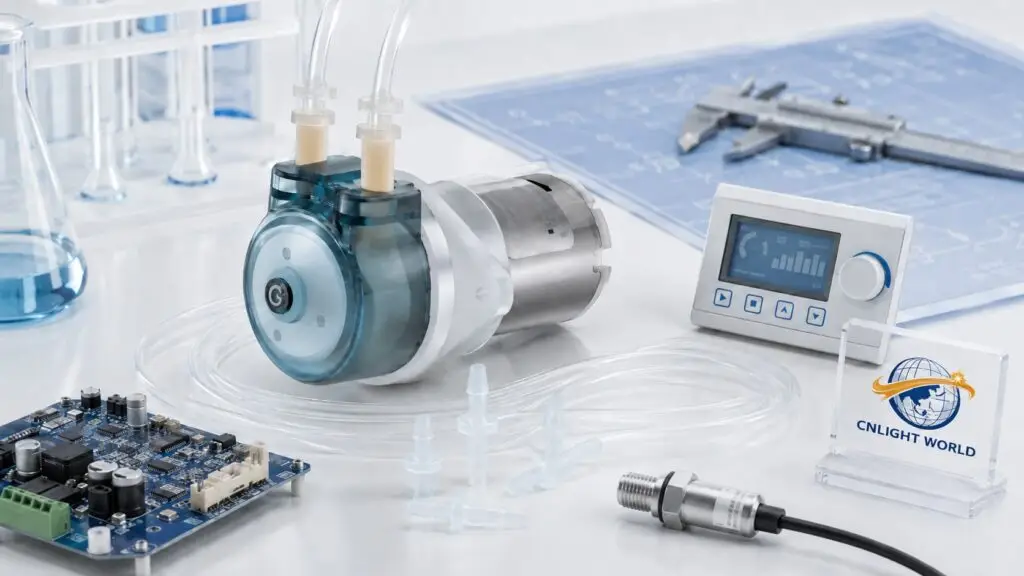
Introduction
Selecting the right pump is a critical decision for many equipment manufacturers and system developers. A pump is not only a component that moves fluid; it directly affects system accuracy, reliability, maintenance requirements, and overall product performance.
For applications that require accurate fluid transfer, controlled dosing, contamination prevention, or flexible operation, a precision peristaltic pump is often one of the most suitable solutions.
Compared with traditional pumping technologies, peristaltic pumps offer unique advantages because the fluid only contacts the tubing, which helps prevent contamination and simplifies maintenance.
However, choosing the right precision peristaltic pump requires careful consideration of several factors, including:
- Flow rate requirements
- Pump accuracy
- Tubing material and size
- Voltage compatibility
- Working environment
- Fluid characteristics
- Customization requirements
This guide explains the key factors engineers and purchasing teams should evaluate when selecting a precision peristaltic pump for their applications.
What Is a Precision Peristaltic Pump?
A precision peristaltic pump is a type of positive displacement pump designed to transfer fluids with high accuracy and repeatability.
Unlike centrifugal pumps or diaphragm pumps, a peristaltic pump works by compressing flexible tubing through a rotating mechanism. This creates a controlled movement of fluid inside the tube.
The main advantage of this design is that:
- The fluid only contacts the tubing
- The pump mechanism remains isolated from the liquid
- Cleaning and maintenance become easier
- Cross contamination risks are reduced
Because of these characteristics, precision peristaltic pumps are widely used in applications requiring accurate liquid handling.
Typical applications include:
- Medical equipment
- Laboratory instruments
- Water quality analysis
- Chemical dosing systems
- Food processing equipment
- Industrial automation systems
How Does a Precision Peristaltic Pump Work?
A precision peristaltic pump usually consists of several key components:
Pump Head
The pump head contains rollers or shoes that compress the tubing.
The rotation speed determines the pumping speed and directly affects flow accuracy.
Tubing
The tubing is one of the most important components of a peristaltic pump system.
The tubing determines:
- Chemical compatibility
- Pressure capability
- Flow consistency
- Service life
Common tubing materials include:
- Silicone
- PVC
- TPU
- Tygon
- Other application-specific materials
Drive Motor
The motor controls the rotation speed of the pump.
For precision applications, DC motors with accurate speed control are commonly used.
Key Factors When Selecting a Precision Peristaltic Pump
1. Determine Required Flow Rate
The first step is identifying the required flow range.
Different applications require different flow characteristics.
Examples:
| Application | Typical Requirement |
|---|---|
| Laboratory dosing | Low flow with high accuracy |
| Medical equipment | Stable and repeatable flow |
| Water treatment | Continuous dosing |
| Industrial equipment | Adjustable flow control |
A pump that provides excessive flow may cause:
- Over dosing
- System instability
- Higher energy consumption
A pump with insufficient flow may result in:
- Poor equipment performance
- Longer processing time
- Reduced efficiency
Therefore, selecting a suitable flow range is essential.
2. Consider Pump Accuracy and Repeatability
For precision applications, accuracy is often more important than maximum flow.
Important parameters include:
Flow consistency
The pump should maintain stable output during operation.
Repeatability
The pump should deliver similar results during repeated cycles.
Speed control
Accurate speed adjustment allows engineers to control fluid delivery precisely.
Applications such as:
- Medical analyzers
- Laboratory testing equipment
- Chemical dosing systems
often require consistent performance over long operating periods.
3. Select the Correct Tubing Material
The tubing is the only part contacting the fluid, making material selection extremely important.
Factors to consider include:
Chemical Compatibility
Different fluids require different tubing materials.
For example:
- Water-based liquids
- Chemicals
- Cleaning solutions
- Biological fluids
may require different tubing choices.
Temperature Resistance
High-temperature applications may require specialized tubing materials.
Flex Life
Since the tubing is continuously compressed during operation, durability is important.
A professional supplier should help customers select the appropriate tubing based on application requirements.
4. Choose the Correct Voltage and Control Method
Many compact equipment systems use DC power supplies.
Common voltage options include:
- 12V DC
- 24V DC
The correct voltage depends on the equipment design.
For OEM applications, engineers should consider:
- Existing power architecture
- Control interface
- Speed adjustment requirements
- Communication requirements
Some customized solutions may include:
- PWM speed control
- External controller integration
- Feedback systems
5. Evaluate Pump Size and Installation Requirements
Space limitations are common in modern equipment designs.
Compact precision peristaltic pumps are especially suitable for:
- Portable instruments
- Medical devices
- Laboratory equipment
- Compact automation systems
Before selecting a pump, engineers should confirm:
- Installation space
- Mounting direction
- Tubing routing
- Connector position
Early confirmation helps avoid redesign costs during product development.
6. Understand Your Fluid Characteristics
Before selecting a pump, provide detailed information about the fluid.
Important questions include:
What is the fluid?
Examples:
- Water
- Chemical solution
- Cleaning liquid
- Biological solution
What is the viscosity?
Higher viscosity fluids may require different pump configurations.
Does the fluid contain particles?
Particle content may affect tubing selection and pump life.
A reliable pump supplier should evaluate these factors before recommending a solution.
Precision Peristaltic Pump Applications
1. Medical Equipment
Precision peristaltic pumps are widely used in medical and healthcare equipment because they provide:
- Accurate fluid delivery
- Hygienic operation
- Easy maintenance
Examples include:
- Cleaning systems
- Analytical equipment
- Diagnostic instruments
2. Laboratory Equipment
Laboratory systems often require:
- Small flow rates
- High repeatability
- Precise dosing
Peristaltic pumps are suitable for:
- Sampling systems
- Testing equipment
- Chemical preparation systems
3. Water Treatment Systems
Water treatment equipment often requires controlled chemical dosing.
Precision pumps help deliver:
- Disinfectants
- Cleaning agents
- Treatment solutions
4. Industrial OEM Equipment
Equipment manufacturers often choose customized peristaltic pump solutions because they can integrate pumps directly into their products.
Customization may include:
- Voltage options
- Tubing selection
- Connector design
- Mounting structure
Why Work With an OEM Precision Peristaltic Pump Supplier?
For equipment manufacturers, selecting a pump supplier is not only about price.
A reliable supplier should provide:
Technical Support
The supplier should understand:
- Application requirements
- Pump parameters
- System integration
Customization Capability
OEM projects often require adjustments in:
- Pump size
- Flow range
- Electrical specifications
- Accessories
Quality Control
Consistent quality is essential for long-term equipment reliability.
Conclusion
Choosing the right precision peristaltic pump requires a complete understanding of your application requirements.
The most important selection factors include:
- Required flow rate
- Accuracy requirements
- Tubing compatibility
- Voltage and control method
- Installation limitations
- Fluid characteristics
For equipment manufacturers and system integrators, working with an experienced pump supplier can significantly reduce development risks and improve product reliability.
Need a Customized Precision Peristaltic Pump Solution?
CNLIGHT WORLD provides compact DC pump solutions for global equipment manufacturers, system integrators, and industrial customers.
Whether you need a standard precision peristaltic pump or a customized OEM solution, our team can support:
- Product selection
- Application evaluation
- Pump customization
- Sample testing
Contact CNLIGHT WORLD today to discuss your pump requirements and find the right solution for your application.
Related Posts: