
Introduction
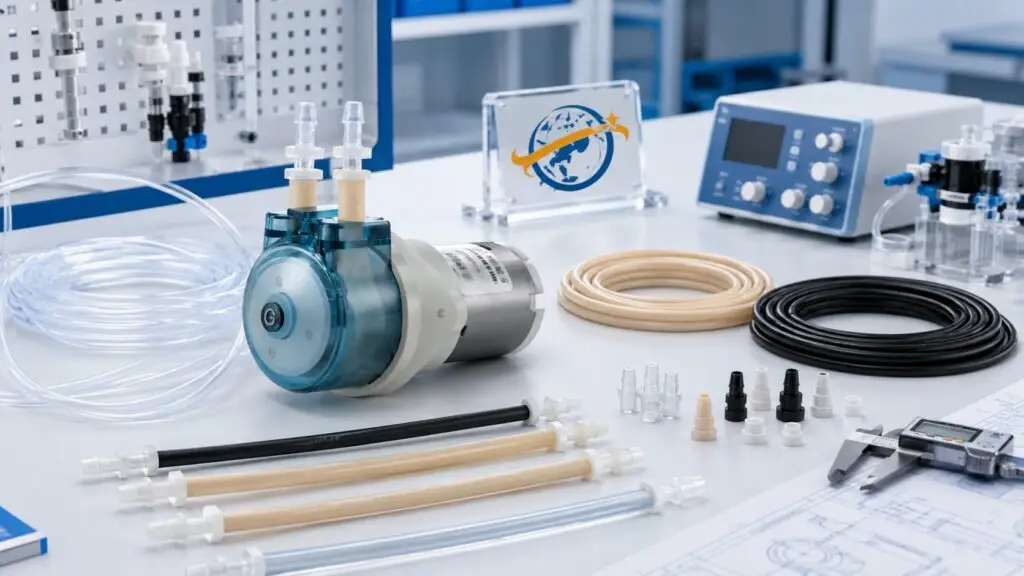
When designing a precision fluid control system, many engineers focus mainly on selecting the pump itself.
However, for a precision peristaltic pump, tubing selection is equally important.
The tubing is the only component that directly contacts the fluid and is responsible for:
- Fluid transfer
- Pumping accuracy
- Chemical compatibility
- Service life
- System reliability
Choosing the wrong tubing material can lead to:
- Reduced flow accuracy
- Shorter operating life
- Chemical damage
- Unexpected maintenance issues
For OEM equipment manufacturers and system integrators, selecting the correct tubing should be considered a critical part of the pump design process.
This guide explains how to choose the right tubing for a precision peristaltic pump system.
Why Tubing Is Critical in a Peristaltic Pump System
Unlike many traditional pump technologies, a peristaltic pump operates differently.
The rollers inside the pump compress the tubing repeatedly to move fluid forward.
Because of this design, tubing performance directly affects pump performance.
Important tubing characteristics include:
1. Elastic Recovery
After compression, the tubing must return to its original shape.
Good elastic recovery helps maintain:
- Stable flow
- Better suction capability
- Longer tube life
2. Flexibility
The tubing must withstand repeated compression cycles.
If the tubing is too hard:
- Pump efficiency decreases
- Motor load increases
If the tubing is too soft:
- Tube deformation may occur
- Flow accuracy may decrease
3. Chemical Compatibility
Different fluids require different tubing materials.
A tube suitable for water may not be suitable for:
- Chemicals
- Cleaning solutions
- Laboratory fluids
Material selection is therefore essential.
Key Factors When Selecting Peristaltic Pump Tubing
1. Understand Your Fluid Characteristics
The first step is identifying the liquid being pumped.
Important questions include:
What type of fluid is being transferred?
Examples:
- Water
- Chemical solution
- Cleaning liquid
- Biological liquid
- Laboratory reagent
What is the viscosity?
Higher viscosity fluids may require:
- Larger tubing size
- Different pump settings
- Higher torque capability
What is the temperature?
Temperature affects tubing performance.
High-temperature applications require materials with suitable temperature resistance.
2. Select the Correct Tubing Material
Different materials provide different advantages.
Silicone Tubing
Silicone tubing is one of the most commonly used materials for peristaltic pumps.
Advantages:
- Excellent flexibility
- Good temperature resistance
- Good elasticity
- Suitable for many general applications
Common applications:
- Laboratory equipment
- Medical devices
- Water systems
Limitations:
- Not suitable for all chemicals
- Mechanical strength may be lower than some materials
PVC Tubing
PVC tubing is commonly used for general fluid transfer applications.
Advantages:
- Cost-effective
- Available in many sizes
- Good chemical resistance for many fluids
Applications:
- Water treatment systems
- General industrial applications
TPU Tubing
TPU tubing provides good mechanical strength and wear resistance.
Advantages:
- Higher durability
- Good flexibility
- Good abrasion resistance
Applications:
- Industrial automation
- Equipment systems
Specialized Chemical-Resistant Tubing
Some applications require special materials.
Examples:
- Aggressive chemicals
- Solvent handling
- High-temperature fluids
The tubing should always be selected based on the actual fluid compatibility requirements.
3. Choose the Correct Tube Size
Tubing dimensions directly affect pump performance.
Important parameters include:
- Inner diameter (ID)
- Outer diameter (OD)
- Wall thickness
The tube size influences:
- Flow rate
- Pressure capability
- Pump speed
- Motor load
Smaller Tubing
Advantages:
- Better precision
- Lower flow rate control
Suitable for:
- Laboratory dosing
- Analytical equipment
Larger Tubing
Advantages:
- Higher flow capacity
Suitable for:
- Fluid transfer
- Industrial systems
4. Consider Flow Accuracy Requirements
For precision applications, tubing selection directly affects dosing accuracy.
Applications requiring high accuracy include:
- Medical equipment
- Laboratory systems
- Chemical dosing equipment
Factors affecting accuracy:
- Tube elasticity
- Tube wear
- Operating temperature
- Pump speed
Regular tubing replacement may be required to maintain accuracy.
5. Evaluate Tube Lifetime
Tubing is a consumable component in most peristaltic pump systems.
Its service life depends on:
Operating Speed
Higher speed means more compression cycles.
Pressure
Higher pressure increases mechanical stress.
Fluid Characteristics
Some fluids accelerate material degradation.
Working Environment
Temperature and installation conditions also affect lifespan.
Tubing Selection for Different Applications
Medical Equipment
Recommended considerations:
- Clean fluid path
- High reliability
- Suitable material compatibility
Common tubing:
- Silicone tubing
- Medical-grade tubing
Applications:
- Cleaning systems
- Diagnostic equipment
- Analytical instruments
Laboratory Equipment
Requirements:
- High accuracy
- Low flow control
- Repeatability
Important factors:
- Tube inner diameter
- Chemical resistance
- Flow stability
Water Treatment Systems
Requirements:
- Chemical compatibility
- Long operation time
- Easy replacement
Applications:
- Dosing systems
- Cleaning systems
- Filtration equipment
Industrial Equipment
Requirements:
- Durability
- Continuous operation
- Cost efficiency
Important considerations:
- Tube life
- Pressure capability
- Maintenance frequency
Common Mistakes When Selecting Pump Tubing
Mistake 1: Selecting Only Based on Price
Lower-cost tubing may reduce initial cost but increase:
- Replacement frequency
- Downtime
- Maintenance cost
Mistake 2: Ignoring Chemical Compatibility
A tube may look suitable but fail after exposure to certain fluids.
Mistake 3: Using Incorrect Tube Size
Incorrect tubing dimensions may cause:
- Reduced flow
- Poor accuracy
- Pump overload
Mistake 4: Ignoring OEM Integration Requirements
For equipment manufacturers, tubing should be considered together with:
- Pump model
- Installation space
- Electrical system
- Application conditions
Working With a Pump Supplier for the Right Tubing Solution
A professional pump supplier should help customers evaluate:
Application Requirements
Including:
- Fluid type
- Flow range
- Operating environment
Pump and Tubing Matching
The supplier should recommend:
- Suitable tubing material
- Correct size
- Compatible pump configuration
Customized Solutions
OEM projects may require:
- Special tubing lengths
- Custom connectors
- Pre-assembled tubing sets
This helps simplify equipment assembly and improve production efficiency.
Conclusion
Selecting the correct tubing is one of the most important steps when designing a precision peristaltic pump system.
The right tubing choice improves:
- Pump accuracy
- Reliability
- Service life
- Equipment performance
When selecting tubing, always consider:
- Fluid characteristics
- Material compatibility
- Tube size
- Flow requirements
- Operating conditions
For OEM equipment manufacturers, working with an experienced pump supplier can help create a complete and reliable fluid handling solution.
Need a Complete Precision Pump Solution?
CNLIGHT WORLD provides compact DC pump solutions including:
- Precision peristaltic pumps
- Tubing and hose solutions
- Pump accessories
- OEM customization support
Our team helps global equipment manufacturers select suitable pump and tubing combinations based on their application requirements.
Contact CNLIGHT WORLD today to discuss your precision pump project.
Related Posts:
How to Choose the Right Precision Peristaltic Pump for Your Application
5 Common Applications of Precision Peristaltic Pumps in Industrial Equipment
Precision Peristaltic Pump vs Diaphragm Pump: Which One Is Better?