
Pump Applications in Medical Cleaning Equipment
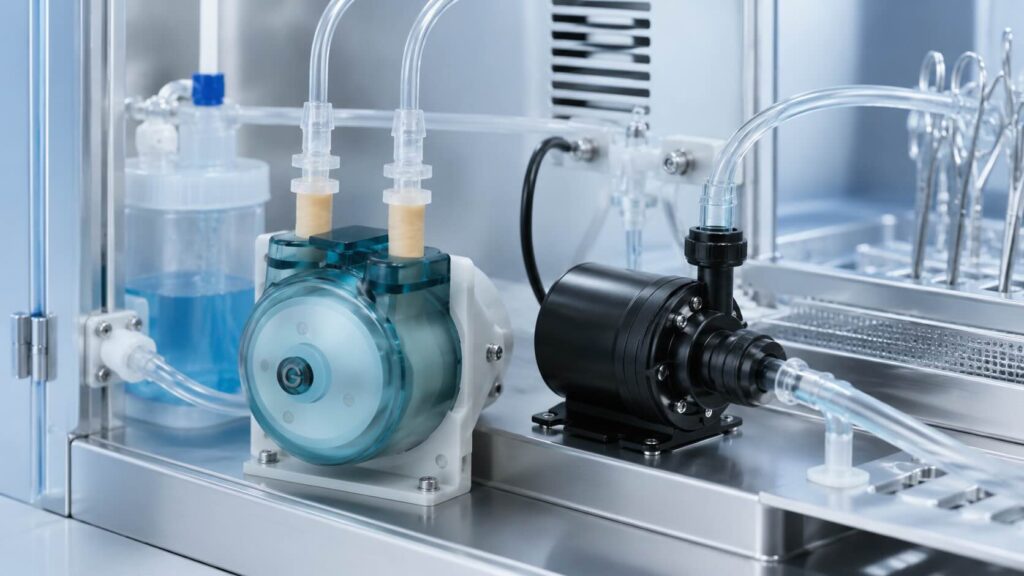
Compact pumps can support medical cleaning equipment by handling rinsing, circulation, liquid transfer, dosing, and controlled fluid movement in space-limited systems. The suitable pump type depends on the liquid path, flow stability, cleaning cycle, tubing compatibility, installation space, and control requirements.
In medical cleaning equipment, fluid handling is often a core part of system performance. Whether the equipment is designed for washing, rinsing, circulation, or controlled transfer, pump selection can directly affect consistency, stability, and integration.
Because these systems are usually compact and application-specific, buyers often need more than a standard pump specification. They need a pump that fits both the technical requirement and the equipment structure.
Why Pumps Matter in Medical Cleaning Systems
Medical cleaning equipment often requires precise and reliable liquid movement in a limited space. In these systems, the pump is not just a supporting component. It can influence cleaning efficiency, fluid delivery stability, and overall equipment design.
Depending on the system, a pump may be expected to support:
- Liquid circulation
- Rinsing or washing flow
- Fluid transfer between chambers
- Pressure support in closed pathways
- Repeated operation in controlled cycles
Because different equipment designs use different fluid paths, pump matching should be based on the actual function inside the machine.
Common Pump Functions in These Systems
1. Circulation
Some medical cleaning systems require continuous or semi-continuous circulation of cleaning liquid. In these cases, stable flow and smooth operation are often more important than peak pressure.
2. Transfer
Certain systems require liquid to be moved from one chamber, tank, or module to another. This may call for controlled fluid transfer rather than simple open flow.
3. Rinsing
Rinsing stages may require repeatable flow delivery over multiple cycles. The pump needs to remain stable while working with the rest of the control system.
4. Pressure Support
In some compact systems, pressure support may be required to maintain delivery performance across filters, tubing, or nozzles.
Each of these functions may lead to a different pump choice, even within the same equipment category.
What Buyers Usually Need to Consider
When evaluating a pump for medical cleaning equipment, buyers should usually confirm:
- Required voltage
- Flow rate under actual working condition
- Pressure or resistance in the fluid path
- Liquid type
- Temperature range
- Space available inside the machine
- Noise expectations
- Duty cycle and service life target
It is also useful to review connector direction, tubing size, and installation orientation early in the project. Small mechanical details can make integration much easier or much more difficult.
Why Compact Design Matters
Many medical cleaning systems are designed with limited internal space. This means the pump must not only perform well, but also fit physically into the structure.
Compact design matters because it can affect:
- Equipment layout
- Tube routing
- Maintenance convenience
- Heat management
- Noise control
In OEM development, a pump that is technically acceptable but difficult to integrate may still slow the project down. That is why application matching and structural fit should be evaluated together.
Final Thoughts
Pumps in medical cleaning equipment are usually chosen for more than one reason. Flow, pressure, size, noise, runtime, and installation details all play a role in the final decision.
For buyers and equipment developers, the best approach is to review the full application logic first and then match the pump accordingly. This makes the sourcing process more efficient and helps reduce trial-and-error during the sampling stage.
If you are developing or sourcing medical cleaning equipment, feel free to share your application details. We can help review pump matching based on your system requirements.
Related Links
Related product: Precision Peristaltic Pumps
Related product: Pump Accessories
Related product: Brushless Circulation Pumps
Related guide: Brushless vs. Diaphragm Pumps
Need Help with a medical or lab liquid transfer Pump Project?
Share your application, voltage, flow rate, pressure, liquid type, installation space, working time, and expected quantity. CNLIGHT WORLD can help you check suitable pump options, supplier availability, sample details, and related accessories for your project.