
Brushless vs. Diaphragm Pumps: Which One Fits Your Equipment?
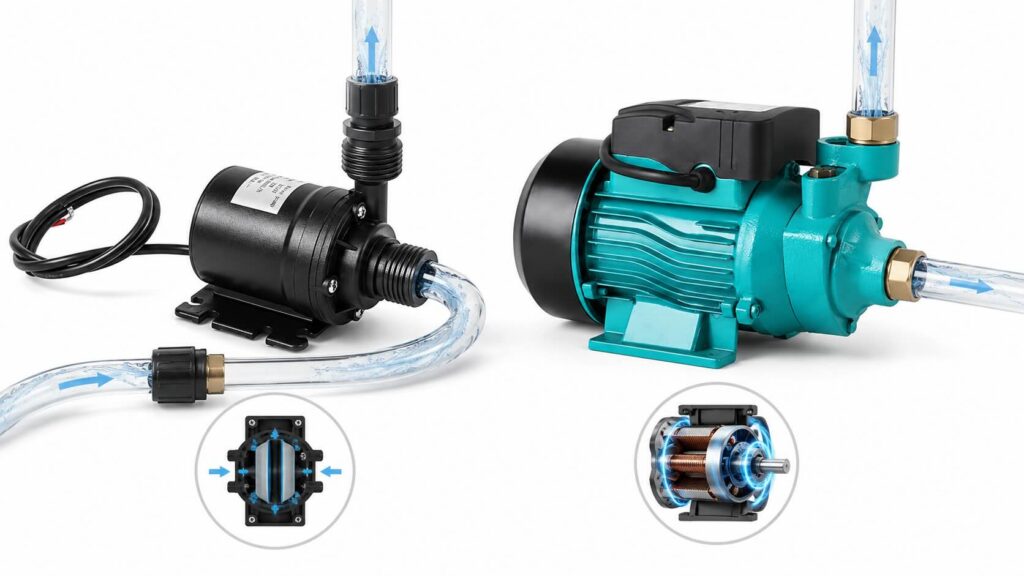
Brushless DC pumps are often suitable for circulation, cooling, and continuous water movement, while diaphragm pumps are often used when pressure, self-priming, or intermittent transfer is needed. The right choice depends on application, flow rate, pressure, duty cycle, noise level, liquid type, and installation conditions.
Choosing the right pump is not only about flow rate or voltage. For many equipment makers and sourcing teams, the real question is which pump structure better fits the actual working condition.
Brushless pumps and diaphragm pumps are both widely used in compact fluid systems, but they serve different needs. Understanding their differences can help buyers avoid mismatched samples, performance issues, and unnecessary rework in later stages.
What Is a Brushless Pump?
A brushless pump is usually driven by a brushless DC motor and is often used for continuous liquid circulation. It is commonly selected for systems that require stable flow, relatively low noise, and long service life.
Typical applications include:
- Water circulation systems
- Cooling systems
- Small equipment fluid transfer
- Solar water circulation
- Compact water treatment modules
In many cases, brushless pumps are preferred when the system needs smooth and continuous operation over a long period of time.
What Is a Diaphragm Pump?
A diaphragm pump works by using a flexible diaphragm to move liquid through a chamber. It is often chosen when the system needs self-priming capability, higher pressure, or intermittent operation.
Typical applications include:
- Pressure boosting
- Dosing or transfer systems
- Equipment with on-off duty cycles
- Compact cleaning systems
- Applications where suction performance matters
Diaphragm pumps are especially useful when the liquid needs to be pulled from a lower source or pushed against higher resistance.
Key Differences That Matter to Buyers
1. Working Principle
Brushless pumps are generally designed for continuous circulation, while diaphragm pumps are designed for displacement and pressure delivery.
2. Pressure Capability
Diaphragm pumps usually perform better in applications where higher outlet pressure is required. Brushless pumps are often more suitable for circulating flow rather than pressure boosting.
3. Self-Priming Ability
In many configurations, diaphragm pumps offer self-priming capability. This can be important in systems where the pump is installed above the liquid level. Brushless pumps usually require flooded or assisted inlet conditions, depending on design.
4. Noise and Smoothness
Brushless pumps are often chosen for quieter and smoother running performance. Diaphragm pumps may generate more pulsation and mechanical noise, especially in compact enclosed equipment.
5. Duty Cycle
Brushless pumps are often a strong choice for continuous operation. Diaphragm pumps are commonly used in intermittent or controlled cycles, depending on the motor and system design.
6. Application Fit
A pump may look suitable on paper, but actual fit depends on the full system. Buyers should consider not just flow and voltage, but also inlet condition, pressure demand, liquid type, installation space, and operating pattern.
Brushless DC Pump vs. Diaphragm Pump Comparison
| Factor | Brushless DC Pump | Diaphragm Pump |
|---|---|---|
| Common use | Circulation and cooling | Pressure boosting and transfer |
| Flow style | Stable circulation | Pulsating transfer |
| Pressure | Usually lower to medium | Often higher pressure |
| Noise | Usually quieter | Can be louder |
| Self-priming | Depends on model | Often available |
| Best for | Water loops, cooling, circulation | Boosting, transfer, intermittent use |
Which One Should You Choose?
A brushless pump may be the better choice if you need:
- Continuous circulation
- Stable flow
- Lower noise
- Compact cooling or recirculation performance
A diaphragm pump may be the better choice if you need:
- Pressure boosting
- Self-priming
- Intermittent delivery
- Better performance against system resistance
For OEM projects, the best decision is usually made after reviewing the full application rather than choosing only by product category.
Final Thoughts
Brushless pumps and diaphragm pumps are both useful, but they are not interchangeable in every system. A pump that works well in one application may perform poorly in another if the working condition is different.
If you are evaluating a new project, it is worth comparing the full operating requirements before selecting a pump type. A better match at the beginning usually saves time, cost, and sample revisions later.
Need support for pump selection or OEM matching? Contact us with your target voltage, flow, pressure, and application details.
Related Links
Related product: Brushless Circulation Pumps
Related product: Precision Peristaltic Pumps
Related product: Home Booster Pumps
Related application: Medical Cleaning Equipment
Need Help Choosing a Suitable DC Pump?
Share your application, voltage, flow rate, pressure, liquid type, installation space, working time, and expected quantity. CNLIGHT WORLD can help you check suitable pump options, supplier availability, sample details, and related accessories for your project.